Roof Color Selection in Minneapolis: How to Pick a Shingle Color That Works in 2026
Roof color is the decision that feels small when you’re signing the contract and huge when the shingles are actually on the house. A Minneapolis homeowner replaces the roof on average every 25–30 years — meaning the color choice you make today is essentially permanent for the next quarter century. And yet most people spend ten minutes on it, flip through a sample book, and pick whatever the contractor recommends.
This is the slow-down guide: roof color selection in Minneapolis. How to match color to architecture, which colors read well in Minnesota light, how the choice affects resale and energy efficiency, and why the most popular Minneapolis roof color in 2026 isn’t the same as it was in 2020.
Roof color selection in Minneapolis: the factors that should drive the decision

Six factors that should shape every Minneapolis roof color decision, in rough order of importance:
- Siding and trim color. The roof is a large visual element; it should complement the home’s primary body color. Generally: warm siding (tan, beige, cream, yellow) pairs with warm-toned roof colors (brown, amber, rust); cool siding (blue, gray, green, white) pairs with cool-toned roof colors (charcoal, slate, blue-gray, black).
- Architectural style. Traditional homes (colonial, cape cod, craftsman) work with most mid-value colors. Modern homes favor darker, monochromatic palettes (charcoal, near-black). Lake homes and cabins favor earth tones and organic textures.
- Neighborhood context. Look at the 10 homes closest to yours. If 8 of them are gray or charcoal, a bright red roof will stand out in a way that may or may not be desirable. If you’re in a historic district with HOA style guides, confirm color is within the approved palette before ordering.
- Minnesota light and season. Minneapolis gets low-angle sun in winter, high overcast in spring, intense direct sun in summer. Test color samples outdoors at different times of day before committing. Grays that look blue-toned at noon can look purple at sunset; browns that look warm in July can look flat in January.
- Resale mindset. For short-to-medium-hold properties, neutral tones (charcoal, weathered wood, driftwood) appeal to the broadest pool of future buyers. For long-hold personal-enjoyment decisions, pick what you love.
- Energy efficiency. Lighter colors reflect more summer heat and can reduce upper-floor cooling loads. In Minnesota, the summer cooling benefit is smaller than in Arizona but still measurable on south-facing slopes — typically 5–12% reduction in upper-floor summer cooling with cool-roof colors.
For how color options vary by material, see the Minneapolis roofing materials pillar. For asphalt shingle brand specifics, best asphalt shingle brands in Minneapolis.
Most popular Minneapolis roof colors in 2026
Market data from shingle manufacturer sales and Minneapolis re-roof orders shows the following color distribution on 2025–2026 installs:
| Color family | Rough share of Minneapolis installs | Typical architectural fit | 2026 trend direction |
|---|---|---|---|
| Charcoal / near-black | ~38% | Universal — works on most styles | Flat to slightly down |
| Weathered wood / driftwood | ~22% | Craftsman, colonial, cape cod | Strong up |
| Slate gray / blue-gray | ~12% | Modern, contemporary, mid-century | Moderate up |
| Brown / amber / rust | ~11% | Traditional, lake home, rustic | Slightly down |
| Hunter green | ~6% | Traditional colonial, lake home | Holding steady |
| Barn red | ~3% | Farmhouse, historic, rural-adjacent | Slight up (farmhouse trend) |
| Pure black | ~3% | Modern, contemporary | Up |
| Cool-roof white / light | ~2% | Modern, energy-focused | Strong up from a small base |
| Custom / other | ~3% | Specialty and premium installs | Variable |
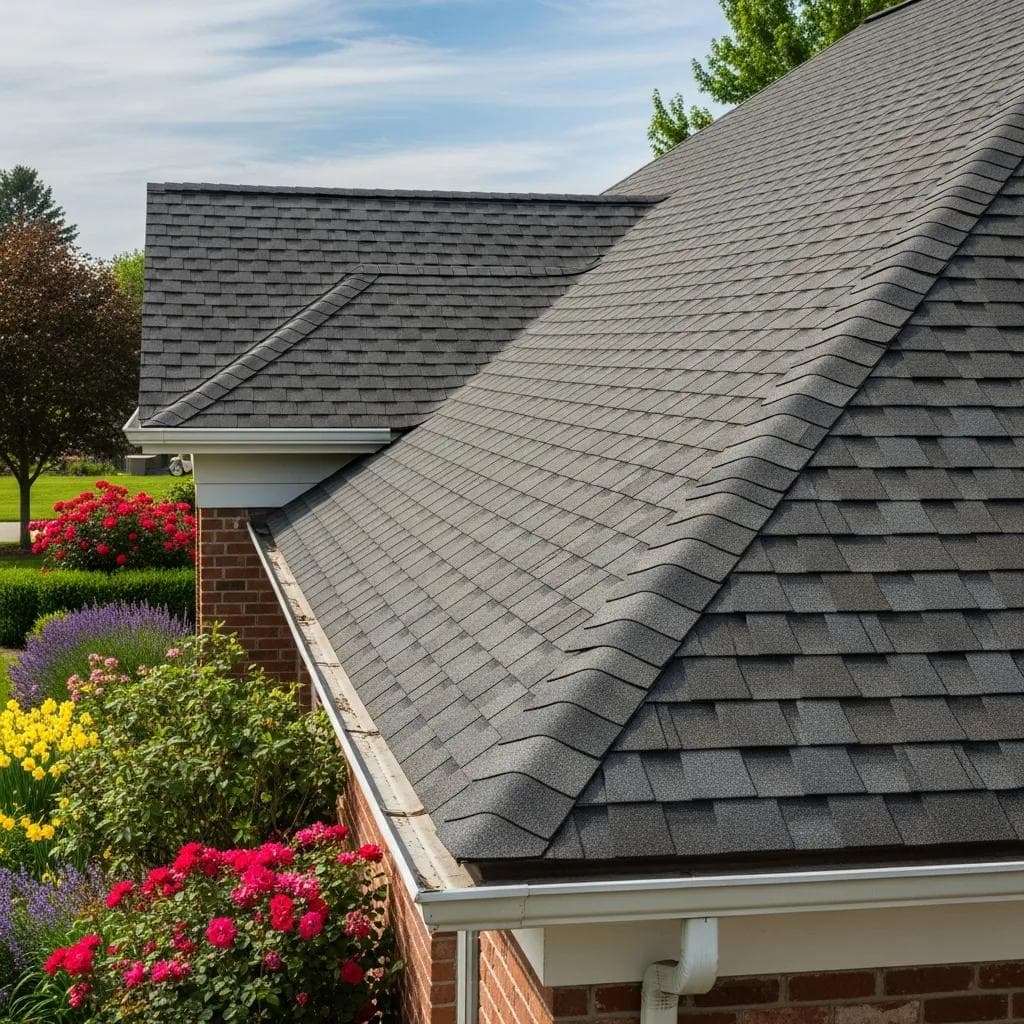
Charcoal / near-black has been the default Minneapolis roof color since the early 2010s and still holds the largest share. The meaningful 2026 trend is the rise of weathered-wood and driftwood tones — multi-tone shingles that blend gray, brown, and tan, presenting a more dimensional appearance on the roof. GAF Timberline HDZ in Weathered Wood, CertainTeed Landmark in Weathered Wood, and Owens Corning Duration in Driftwood are the dominant products in this trend.
Pure black is having a moment on modern-style Minneapolis homes, particularly newer builds in Northeast and upscale remodels. The look pairs with black window frames and modern siding palettes that have grown fast since 2022.
Energy efficiency and roof color in Minneapolis: the cool-roof question
Does a lighter roof color meaningfully reduce energy costs in Minneapolis? The honest answer is: somewhat, but less dramatically than in southern climates. Specifics for Minnesota:
- Summer cooling benefit. Measurable but modest. A cool-roof-rated light-colored shingle can reduce upper-floor summer cooling costs by 5–12% compared to dark shingles. On a $200/month summer cooling bill, that’s $10–$24 per month.
- Winter heating penalty. Slight but real. Lighter roofs in winter don’t absorb as much passive solar heat, marginally increasing heating costs. In Minnesota’s long heating season, this partially offsets the summer savings.
- Net annual energy impact. Typically 2–5% reduction in total annual HVAC energy cost for a cool-roof light shingle vs. dark in Minneapolis. That’s real but not a primary decision driver.
- Cool-roof-rated shingle availability. Most major manufacturers offer cool-roof-rated lines: GAF Timberline Cool Series, CertainTeed Landmark Solaris, Owens Corning Duration COOL. Priced at a small premium (typically +$0.30–$0.60 per sq ft) over equivalent standard lines.
- ENERGY STAR qualification. Some cool-roof shingles carry ENERGY STAR certification. Not particularly impactful in Minneapolis from an energy-savings standpoint, but useful for certain green-building certifications (LEED, MN GreenStar).
Translation: cool-roof colors have merit in Minneapolis but should be a secondary decision driver behind aesthetic and neighborhood fit. The climate-focused homeowner who values even small energy gains may well prefer a cool-roof light shingle; the aesthetic-focused homeowner shouldn’t feel compelled to choose light just for the modest energy upside. For the total cost picture including potential energy savings, see the Minneapolis roof replacement cost pillar.
The roof color decision is where homeowners reliably overthink or underthink. Overthinking: agonizing over three virtually identical grays for weeks. Underthinking: picking whatever the contractor recommends in 30 seconds. The sweet spot is about 90 minutes of attention spread over a week: order 4–5 sample boards, look at them on the house at different times of day, show them to one honest friend who won’t just tell you what you want to hear, and then decide. That’s enough process to land on a color you’ll still like in 25 years.
— Paraphrased from a 2024 National Association of Home Builders homeowner education briefing on exterior color selection
Practical roof color selection process for your Minneapolis install
Five-step process to land on the right roof color for your Minneapolis home without wasting weeks or regretting the choice:
- Pre-screen 4–5 candidate colors. Based on your siding, architecture, and neighborhood, narrow to 4–5 candidate colors across your chosen shingle brand. Eliminate colors that clearly don’t fit before ordering samples.
- Order full-size sample boards. Not tiny swatches — full shingle-size samples, ideally 8×12 or 12×18 inches, from the manufacturer or contractor. Small swatches read differently than the actual roof scale.
- Test on the house in different light. Hold the samples against the siding at 9 AM, noon, 4 PM, and dusk. A color that looks perfect at noon can look wrong at dusk. Minnesota’s seasonal light variation is significant — test in both sunny and overcast conditions if possible.
- Check neighborhood context. Drive your street and adjacent streets. If your candidate color isn’t represented at all within 5 blocks, that’s worth noticing. Unusual isn’t always bad, but know what you’re signing up for.
- Get a second opinion from an aesthetic-trusted person. Your partner, a designer friend, a realtor — anyone whose taste you trust and who will give you an honest read. Not the contractor; they’re trying to close the deal and will say whatever you want.
For contractor selection and color-ordering logistics, see the Minneapolis roofing companies pillar. For the Class 4 hail question that often comes up alongside color selection, impact-resistant Class 4 shingles in Minneapolis. For the architectural vs. 3-tab decision that precedes color (color options are much broader on architectural), architectural vs. 3-tab shingles in Minneapolis. For storm-claim color-matching dynamics that can affect replacement specifications, the Minneapolis storm damage claim pillar. Further reading: the ARMA asphalt roofing color resource, the ENERGY STAR roof products, and the NRCA consumer center.
Frequently Asked Questions
What’s the most popular roof color in Minneapolis?
Charcoal / near-black remains the largest category on 2026 Minneapolis roof installs at roughly 38% of orders. Weathered-wood / driftwood multi-tone shingles are the fastest-growing category at roughly 22% and rising. Slate gray / blue-gray is common on modern homes. Browns, greens, and reds are secondary categories for specific architectural styles.
Does roof color affect energy efficiency in Minneapolis?
Yes, but modestly. Cool-roof-rated light colors can reduce upper-floor summer cooling costs 5–12% compared to dark shingles. However, Minnesota’s long heating season partially offsets summer savings with a slight winter heating penalty. Net annual HVAC savings typically 2–5% — real but not a primary decision driver.
How do I pick the right roof color for my Minneapolis home?
Start with siding and trim color (warm pairs with warm, cool pairs with cool), consider architectural style and neighborhood context, order 4–5 full-size sample boards from candidate colors, test on the house at different times of day, and get a second opinion from someone whose taste you trust. Budget about 90 minutes over a week for the decision.
Should I pick a light or dark roof color in Minneapolis?
Both work. Dark colors (charcoal, near-black) dominate Minneapolis installs and fit most architectural styles. Light colors (cool-roof whites, tans, soft grays) offer modest energy savings and work on modern or contemporary homes. Decision should be primarily aesthetic and neighborhood-fit-driven rather than energy-driven.
Will a non-traditional roof color hurt my Minneapolis home’s resale value?
Sometimes, yes. Non-traditional colors (bright red, blue, pure white) can narrow the future-buyer pool on a short-to-medium-hold property. For short-hold properties, neutral tones (charcoal, weathered wood, driftwood) typically appeal to the broadest buyer audience. On a long-hold personal residence where resale isn’t a near-term concern, pick what you genuinely love.
Looking for a Minneapolis roofer who helps homeowners pick the right shingle color?
We’re Minneapolis Roofing Company — a licensed, insured, local crew that installs asphalt, metal, and synthetic systems across the Minneapolis metro. If you’re looking for a Minneapolis roofer who helps homeowners pick the right shingle color, we’d love to be the name you recommend to your neighbor after the install.
